


HenryYHW/DriveDNA-models
Updated





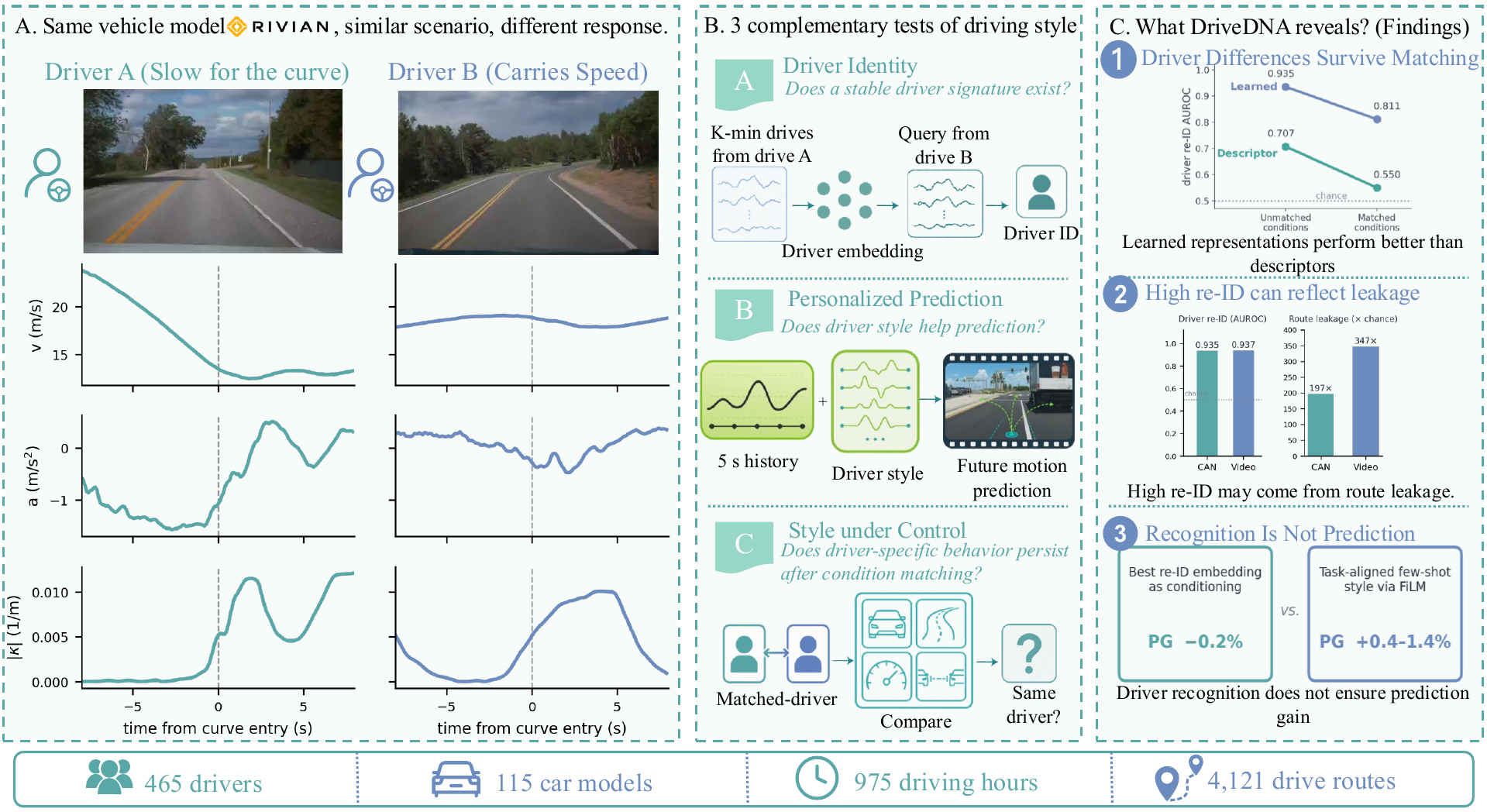
Recognizing a driver is not the same as capturing driving style — DriveDNA makes vehicle, route, and driving-condition shortcuts measurable.
The sample dataset opens after accepting the research-use terms (automatic approval, no manual review): DriveDNA-Sample
DriveDNA turns a large, in-the-wild naturalistic driving corpus into a benchmark for personalized driving style: representing who is driving as distinct from what they are driving and where. It pairs time-synchronized CAN telemetry (10 Hz) and forward-road video across hundreds of drivers and vehicle models, retains only human-controlled driving (automation-engaged frames removed), and ships a frozen evaluation protocol whose central question is:
Does a model recognize how a person drives — or merely which car they own, which roads they frequent, and which conditions they encounter?
Why it's unique. Public personalized-style resources are small and hold vehicle/route fixed (e.g., PDB: 12 drivers, one car), while large AV datasets (nuScenes, Waymo) carry no persistent driver identity. DriveDNA is the first public corpus combining many drivers × many vehicles × multi-session CAN+video, with clean human-vs-automation separation and explicit confound diagnostics.
| 🧑✈️ Drivers | 460 released drivers with persistent de-identified identities (driver_001 … driver_460), consistent across vehicles; the paper's corpus statistics cite 465 decoded drivers |
| 🚗 Vehicle models | 115 nameplate-level models across 26 brands (paper consolidation). In the release index, 426 drivers share a model with at least one other driver and 22 appear on two or more models; within the 428-driver benchmark cohort these counts are 392 and 20 (see Counts) |
| 🛣️ Drives | 4,121 decoded drives (Mar 2023 – Jul 2026, multi-continent) |
| ⏱️ Human-controlled driving | 975 h total, 581 h in motion, at 10 Hz with forward video |
| 🪟 Benchmark windows | 62,674 tagged 60-s windows from 428 drivers (355 in frozen folds) |
| 🏷️ Annotations | 6 driving scenarios · 8 behavioral primitives (93.0% audit agreement) · 276,248 maneuver events incl. 22,322 individually verified lane changes |
| 🧪 Protocol | Driver-disjoint splits · 3-seed error bars · frozen evaluation manifests · leakage probes |
All streams are decoded from openpilot logs and resampled to a unified 10 Hz grid:
| Signal | Meaning | Style construct |
|---|---|---|
vEgo, aEgo (+ jerk) |
speed, longitudinal accel | longitudinal aggressiveness |
steeringAngleDeg, steeringRateDeg |
driver steering INPUT (vehicle-dependent via steer ratio) | steering entropy, reversal rate |
actual_curvature |
realized path curvature (vehicle-normalized) | cornering sharpness, path geometry |
yaw_rate → curv_measured |
independently-sensed turning | aggressiveness, slip |
leadOne_dRel/vRel/status |
lead-vehicle distance & relative speed (radar) | THW, TTC, gap preference |
gas, brake (+ pressed) |
pedal application (subset of fleet) | pedal dynamics |
laneLeft_y, laneRight_y |
lane offsets | lane-keeping (SDLP) |
Key distinction — steering INPUT vs realized PATH. steeringAngleDeg is the raw wheel input and is vehicle-dependent; actual_curvature is the vehicle-normalized realized path. Their gap is a signal-level handle on the "who vs which-car" question at the heart of the benchmark: vehicle-model probes read 2.3× chance from steering angle but ≈chance from realized curvature.
| Task | Input → Output | Metrics |
|---|---|---|
| Driver re-identification (core) | k-min support → driver identity | Top-k, AUROC, EER |
| Personalized behavior prediction (core) | 5-s history → 1–5-s future motion | RMSE, PG, MMD/KL/W1 |
| Condition-matched comparison (core) | matched window pair → same driver? | AUROC, EER |
| Event forecasting (optional) | 5-s history → event in 1–5 s | AP, AUROC, lead time |
| Style explanation (optional) | event window → category + evidence | accuracy (exploratory) |
The main driver-disjoint split is 212 train / 45 val / 45 test, plus a 53-driver few-shot hold-out (support and query always from different drives). Additional frozen manifests isolate generalization sources: within-nameplate (same model, different drivers, 24 models), cross-vehicle (same driver, different vehicles), condition-matched pairs (14,868), and missing-channel robustness.
| Finding | Evidence |
|---|---|
| Learned representations ≫ classical descriptors | AUROC .935 vs .707 on unseen drivers |
| Driver signal survives condition matching | .811 ± .006 on 14,868 matched pairs (descriptors → .550, chance) |
| High re-ID ≠ driving style | Video-only probe hits .937 re-ID but predicts route at 347× chance; collapses to .675 under matching |
| Recognition ≠ prediction | Best re-ID embedding yields no prediction gain (−0.2%); task-aligned FiLM conditioning does (+0.4 to +1.4%) |
| Foundation models need adaptation | Zero-shot LLM/TS/VLM rows land at/below the descriptor level; 1-epoch LoRA lifts Qwen3-8B to .871 on event forecasting |
30 baseline configurations across five families — representation learning, shortcut robustness, personalization, multimodal modeling, distributional prediction — under one fixed multi-seed protocol.
This gated repository contains the complete release (data files frozen at revision 1f9c67170db726c977686ebe6ca86284f2aed444; access is granted on request under the research license): de-identified 10 Hz signal tables · raw forward road video (low-resolution 526×330 dashcam view, 1-min segments) · frozen video embeddings (DINOv2/DINOv3/SigLIP2/V-JEPA 2) · all split manifests · VLM scene attributes. The evaluation harness and baseline code live in the GitHub repo.
The signal tables, features, and manifests alone reproduce every number in the paper; video is provided for multimodal research under the same research-only license.
Repository layout (~325 GB):
DriveDNA/
├── README.md · LICENSE
├── data/
│   ├── windows.parquet              # 62,674 benchmark windows: driver, drive, scenario, 8 primitives, stats
│   ├── maneuver_events.parquet      # 276,248 maneuver events (window-indexed)
│   ├── lane_changes_verified.parquet# individually verified lane-change rows
│   ├── vlm_attrs.jsonl / vlm_attrs_qwen3.jsonl   # per-window VLM scene attributes
│   └── t5_llm_subsample.parquet     # frozen 3,000-window event-forecasting subsample
├── features/
│   ├── windows_x.npy                # [62674, 600, 17] 10 Hz CAN windows (+ windows_mask.npy, channels.json)
│   └── windows_vid*.npy             # window-aligned frozen video features (DINOv2/DINOv3/SigLIP2/V-JEPA 2)
├── raw_signals/
│   └── driver_XXX/drive_YYY.parquet # full 10 Hz signal table per drive — 4,121 drives, 460 drivers
├── raw_signals_csv/
│   └── driver_XXX/drive_YYY.csv     # the same tables as CSV
├── embeddings/
│   └── {dinov2,dinov3,siglip2,vjepa2}/driver_XXX/drive_YYY.npz   # per-drive frame embeddings
├── videos/
│   └── driver_XXX/drive_YYY/segN.mp4 # forward road video, 1-min segments (526×330); segN aligns with embeddings
├── splits/                          # driver_folds / cross_route / within_vehicle / cross_vehicle / matched pairs
├── index/
│   ├── drives.parquet               # one row per drive: model, human fraction, fold, month, durations
│   └── human_segments.parquet       # 12,440 human-driving spans: i0/i1 row range + t0/t1 seconds per drive
└── paper/                           # the submitted PDF
The evaluation harness, every baseline, the result files behind the paper's tables and the exact environment are in the GitHub repository (tag v1.1-kdd2027); trained checkpoints are in HenryYHW/DriveDNA-models.
driver_001 … driver_460 and each driver's drives as drive_001 … drive_NNN (per-driver, chronological). The raw-ID mapping is held privately by the authors and is append-stable: future data additions never renumber existing entries.raw_signals/ tables contain all frames of each drive, including ADAS-engaged frames (cs_enabled / cruiseState_enabled flags included). To reproduce the paper's human-only analysis, slice each drive with index/human_segments:import pandas as pd
seg = pd.read_parquet("index/human_segments.parquet") # human-driving spans
s = seg[(seg.driver == "driver_042")].iloc[0]
sig = pd.read_parquet(f"raw_signals/{s.driver}/{s.drive}.parquet")
human = sig.iloc[int(s.i0):int(s.i1)] # 10 Hz rows, human-controlled & moving
index/drives.parquet is the master index: per drive it lists the consolidated vehicle model, human-controlled fraction, minutes of moving human driving, number of human spans, benchmark fold of the driver, and month of recording.Different numbers refer to different cohorts; each is reproducible from the released files with code/preprocessing/model_merge.py (nameplate-level model consolidation) in the GitHub repository.
| Cohort | Drivers | Share a model with ≥1 other driver | On two or more models |
|---|---|---|---|
Release index (index/drives.parquet, all 4,121 drives) |
460 | 426 | 22 |
Benchmark window cohort (data/windows.parquet, 62,674 windows) |
428 | 392 | 20 (7 admit model-matched negatives, Appendix G) |
The paper's corpus statistics (465 decoded drivers; 420 sharing a model) were computed on the decoded corpus before the release index was frozen; the camera-ready version will carry the release-index figures above with these definitions. Placeholder vehicle labels (UNKNOWN in the index, MOCK in the windows table) are counted as a model in these figures, as in the paper; excluding them gives 411 / 18 (release index) and 379 / 18 (benchmark cohort), with 117 and 115 real nameplates respectively. splits/cross_vehicle.json lists the 16 drivers with drive-disjoint data on two or more models. Forward video exists for 3,983 drives (452 drivers) and the four embedding families for 3,891 of them.
hf download HenryYHW/DriveDNA --repo-type dataset --local-dir ./hf/DriveDNA
git clone https://github.com/WangYuHang-cmd/DriveDNA && cd DriveDNA && git checkout v1.1-kdd2027
python scripts/prepare_release_layout.py --data ../hf/DriveDNA      # builds the layout the scripts expect
The repository README maps every table of the paper to the command that reproduces it; CHECKSUMS.sha256, ENVIRONMENT.md and results/ hold the checksums, the exact package versions and the result files. The 14-driver same-vehicle companion set DriveDNA-Controlled uses the same format.
driver_001/drive_001); the private raw-ID mapping is withheld by the authors. VINs, device identifiers, precise timestamps, and GPS coordinates removed; no cabin video/audio; forward road video is exterior-only, low-resolution, released under gated research-only access.@article{drivedna2026,
title = {DriveDNA: A Large-Scale Multimodal Naturalistic Driving Dataset and
Benchmark for Driving Style Identification},
author = {Wang, Yuhang and Li, Lingyao and Zhou, Hao},
journal = {arXiv preprint arXiv:2607.23822},
year = {2026}
}
v1.1-kdd2027 (checksums, environment, result files, reproduction commands)1f9c6717 · DriveDNA-Sample (no approval needed) · DriveDNA-Controlled · 🧠 DriveDNA-models